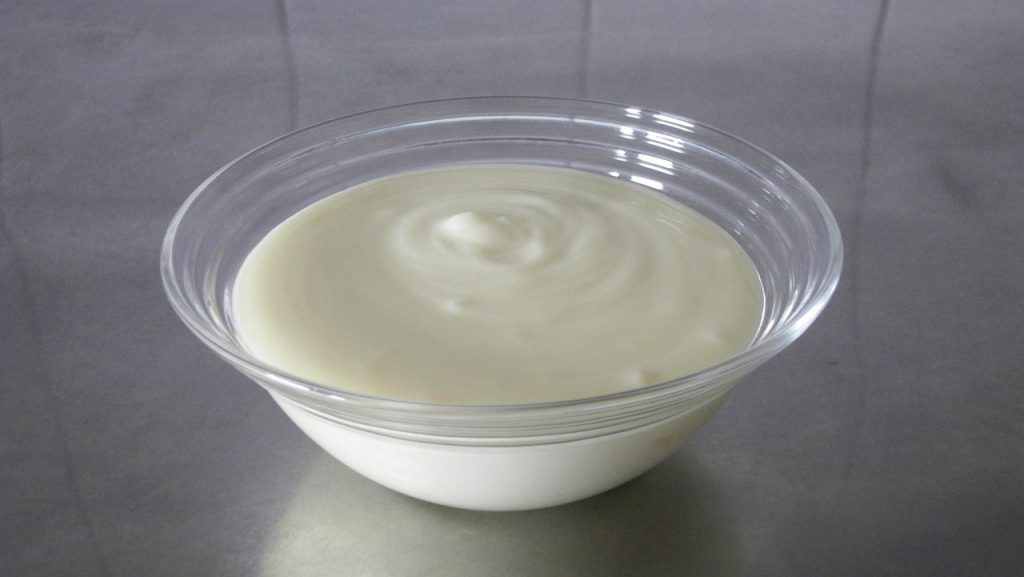
But I was going to have tea at Rovaniemi, and the food on the train — this is a very, very, very old train. So the food booth — it was a, like, it was about less than half the size of an Amtrak snack bar. Small, this is small. So the poor attendant was — I would hate to be the poor attendant ’cause you’re in a cramped space all day riding on that train. Of course, I don’t speak Finnish and I don’t read Finnish. I’m just a tourist in Finland. And the poor, poor attendant is there to serve Finnish customers. So she doesn’t speak English. So I can’t read anything that’s on the snack bar menu, anything that’s on the labels of the food products in that little refrigerator sec- section of the, of the snacks. I’m just, and I’m just having to guess what anything is. So there’s a container that looks like a yogurt container, and I point to it and I, I, you know, I ask, “What’s, what’s that?” And she can’t understand English too much. The best she can manage, manage to say is, “Yogurt.” So, I buy it. She gives me a spoon. I take it back to my seat.
And, it looks like yogurt inside, but when you pull out a spoon, instead of just the spoonful of yogurt coming out of the container, what you’ve pulled out on your spoon, it’s, it’s like, goo? It’s still connected to what was in the container. So you pretty much have to just put it in your mouth and cut it with your teeth, or cut it with your lips to make that band — a band that’s connecting the spoon to inside the container, to cut that. It was very gooey, and visually, if you remember the Ghostbuster- — the original Ghostbusters movie, there was a toy called Slime. It was like that, that’s what it looked like, Slime, ‘cause, because, it — There was that connection between the spoon, what you held, what you held up on the spoon, and the yo- yogurt that was still in the container, it just didn’t separate. It was all connected. I found out later that the English term was curds and whey.