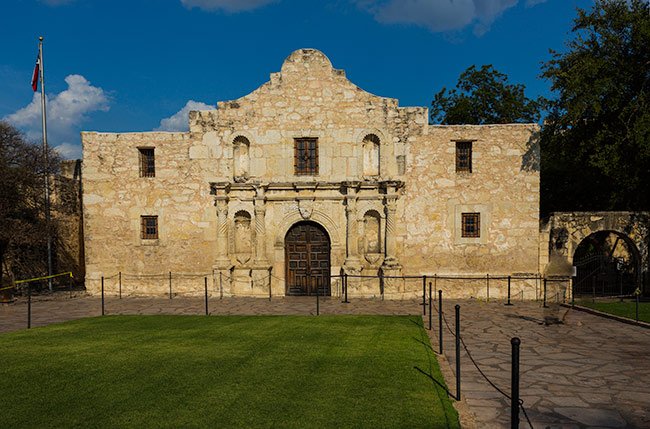
Back in the ’70s, I taught US history and I — it was one of the first or second years that I taught and I’d assigned a project to the kids, and it was a group project and they were working with a partner. And these two boys decided to build a model of the Alamo. And so they built it out of sand, and they brought it in on a wooden board and it looked really great. It looked exactly like the Alamo. They had done a wonderful job sculpting it out of sand. And, they did a great job, they did their presentation, they talked about it, they explained how big it was, they talked about the battle, they did just a wonderful job on their, on their project. I was very pleased with them and they got a good grade and they were really happy with the way their sculpture of the fort had turned out.
So the next morning before school, when I got to the classroom, and I went to the back to kind of look over the projects just one more time before the kids took ’em home, I realized that their sand had been put together with water and the water had dried up overnight and the whole thing was just a pile of sand on board. And I thought to myself, well it’s a good thing I graded them yesterday.
And about that minute, the two boys and some friends of theirs came in and they said, “Oh Mrs. [Name], we came, we wanna show our friends the, the Alamo that we made.” And I said, “Oh, dear.”
And they said, “Why, what happened?” And I said, “I didn’t touch it. I want you to know, I did not touch your project.” And the boys said, “Why, what’s wrong with it?” I said, “Come on. You gotta look at this.”
I said, “You made it out of sand and you could — before I had it, it was all wet sand, right?” They went, “Yeah.” And I said, “Look what happened when it dried out.”
And they went, “Oh my gosh, we’re gonna fail.” I said, “No, you’re not gonna fail. You did a wonderful job on your project and I graded it yesterday, you’re fine. But,” I said, “You do have to do one thing for me,” and they said “What?”
And I said, “Your job is to take this very carefully out of the classroom to the big trash can out in the hall, and very carefully put the sand in the trash can, and then you can bring the empty board back in and then take it home this afternoon after school.” And they went, “We can do that.” I said, “Just don’t drop the whole pile of sand, ’cause,” I said, “that will be a big mess.” They said, “Yeah, we, we understand, we won’t — we won’t.” And they didn’t.
The following couple of days, and this is back when 14-year-olds could work at the grocery store packing — bagging, uh, groceries. And this kid worked — his mom worked in a, of all things, in the Piggly Wiggly. And I went to the grocery store, and I went to the Piggly Wiggly and his mom ended up being my cashier, and he was bagging for her. And when I got done and I said to her son, I said, “Did ya tell your mom what happened to your project?”
And his mom started laughing, and she said, “I’m so glad you graded that before it, it dried up.” And I said, “Oh, me too.” I said, “It looked beautiful.” She said, “Oh, it looked great.” She said, “I was so pleased with how it ended up turning out.” I said, “Oh, me too. I thought it looked good.” We just had the biggest laugh right there in the Piggly Wiggly and the kid was kinda like, “I can’t believe it dried up like that.” I said, “I can’t believe it did either, but hey, it doesn’t matter. It’s over and you did well, so that’s all that matters.”